

The ICMol 2D-Chem group brings science closer to more than 500 schoolchildren
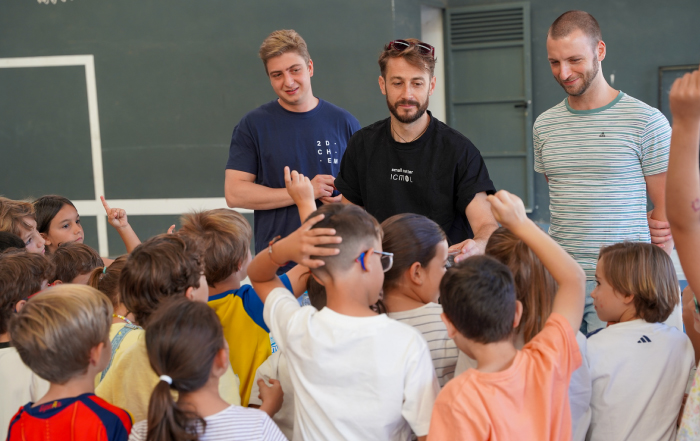
The 2D-Chem group at the Institute of Molecular Science (ICMol), a research centre of the Universitat de València, has organised a new edition of its science outreach week, aimed at more than 500 primary school children.
This is the third time the group has promoted this initiative, whose aim is to bring science closer to young children through experimental, participatory workshops adapted to each educational level. The activity seeks to spark scientific curiosity from an early age and to show that science can also be learned through play, observation and hands-on experimentation.
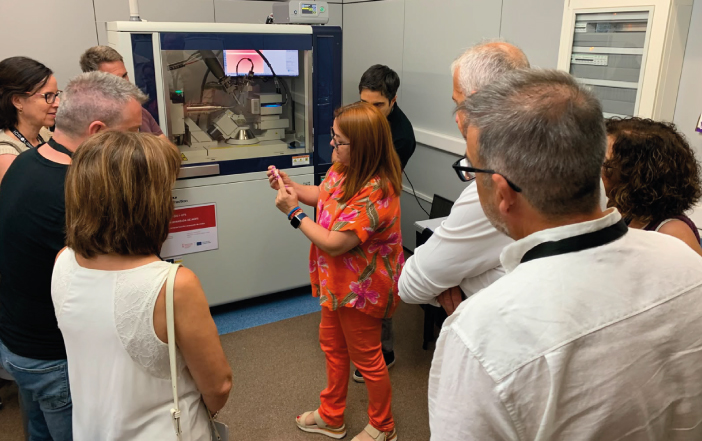
Researchers from the 2D-Chem group took part in the initiative, visiting classrooms to accompany pupils during the sessions, explain scientific concepts in an accessible way and guide the development of the experiments.
Throughout the week, pupils took part in different workshops related to everyday scientific phenomena. In Year 1 of Primary Education, children worked with slime and pH experiments using red cabbage, an activity that shows how some foods can act as natural indicators of acidity or basicity through colour changes.
In Year 2, the workshops included the “balloon without air” experiment, which introduces basic concepts about gases and chemical reactions, as well as the creation of a rainbow, a visual activity designed to explore mixtures, colours and densities in a simple way.
Year 3 pupils took part in activities such as Kryptonite and the oil volcano, experiments designed to observe differences in density, the behaviour of liquids and reactions that generate movement inside a container.
For Year 4, the workshops included elephant toothpaste, a striking reaction that helps explain gas release and foam formation, and fluorescent slime, which combines polymer chemistry with an engaging visual experience for students.
The older pupils also participated in activities adapted to their age. In Years 5 and 6, they carried out experiments such as extracting DNA from a banana, which allows them to observe genetic material in a simple way using an everyday sample, and the non-Newtonian solid, an experiment with materials that behave differently depending on the pressure applied, introducing basic concepts of materials physics.
The programme enabled each group to work with experiences suited to their level, while maintaining a practical and participatory approach throughout. With this initiative, ICMol reinforces its commitment to science outreach and the transfer of knowledge to society, promoting interest in science from an early age and bringing research activity into the classroom.
.jpg)