

ICMol scientists develop a new chemical strategy to control altermagnetism through spin transitions
A team of researchers from the 2D Smart Materials Lab at the Institute of Molecular Science (ICMol) of the Universitat de València has developed a new strategy to externally control altermagnetism in molecular materials. The study, published in the prestigious Journal of the American Chemical Society (JACS), demonstrates that a pressure-induced spin transition can switch this magnetic property on and off.
Altermagnetism represents a new class of magnetism with particularly promising properties for spintronics, a technology that aims to exploit electron spin to transmit and process information. One of the main challenges for its practical application is achieving reversible control of this magnetic state through external stimuli.
The study, led by ICMol researcher José J. Baldoví, focuses on the design of layered manganese-based metal–organic frameworks (MOFs) using first-principles simulations. The results show that these materials initially exhibit a symmetry-allowed altermagnetic state and an electronic response capable of separating electron currents with opposite spins. Under applied pressure, manganese undergoes a transition from a high-spin to a low-spin state. This change modifies the magnetic interactions and transforms the altermagnetic state into a conventional antiferromagnetic state, effectively acting as an on/off switch for altermagnetic spin splitting.
This research establishes spin transitions as a mechanism for controlling altermagnetism for the first time. Since spin transitions can be induced by external stimuli such as pressure, temperature or light, the findings open up new possibilities for designing reconfigurable magnetic materials and future spintronic devices.
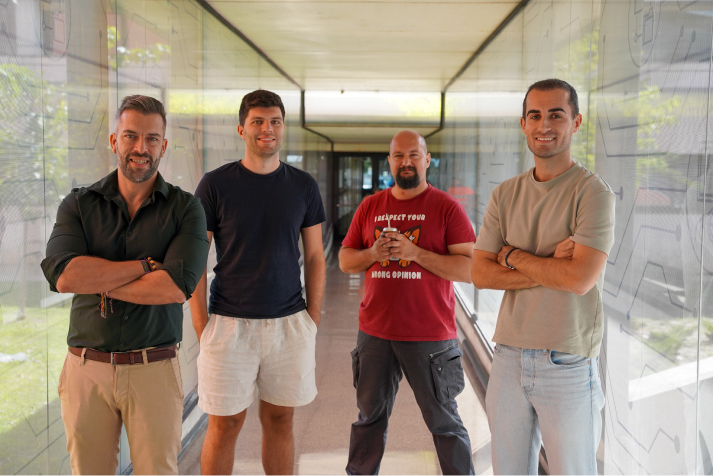
The article is authored by Diego López Alcalá, whose contribution forms part of his doctoral research, Alberto M. Ruiz, Andrei Shumilin and José J. Baldoví, principal investigator and head of the 2D Smart Materials Lab. All four authors conduct their research at the ICMol of the Universitat de València.
The research was funded by the European Union through the European Research Council (ERC 2D-SMARTIES project), the Spanish Ministry of Science and Innovation (2D-MAGIC project) and the Generalitat Valenciana's GenT Programme (2D-SWiMS project).
The Institute of Molecular Science (ICMol) at the Universitat de València focuses its research on the molecular aspects of nanoscience and the study of materials exhibiting magnetic, electrical and optical properties. Since 2015, it has been recognised by the Spanish government as a María de Maeztu Unit of Excellence.